Travel from Rome into the heart of Tuscany, where hill towns and sun-drenched vineyards hold centuries of tradition. You'll get to sip Vino Nobile in Montepulciano, gaze across the Val d'Orcia, wander Siena's bustling market and uncover Volterra's Etruscan past.
Montalcino: Pause in Montalcino to take in views over the Val d’Orcia, the UNESCO-listed landscape seen in Gladiator. From this hilltop position, look out across the cypress-lined roads, fields and villages that have made this one of Tuscany’s most recognised landscapes.
Montepulciano: Explore Montepulciano with your Travel Director before tasting Vino Nobile di Montepulciano, the DOCG red produced in the vineyards around the town. Made primarily from Sangiovese, known locally as Prugnolo Gentile, it is one of Tuscany’s best-known wines and a defining part of Montepulciano’s identity, served where the wine’s story begins.
Pienza: Explore Pienza with your Travel Director and get to know the town Pope Pius II reshaped as his ideal Renaissance city. Its orderly streets, stone buildings and compact historic centre give it a very different feel from Tuscany’s medieval hill towns. While you’re here, taste the pecorino cheese that has long been associated with Pienza and the surrounding countryside.
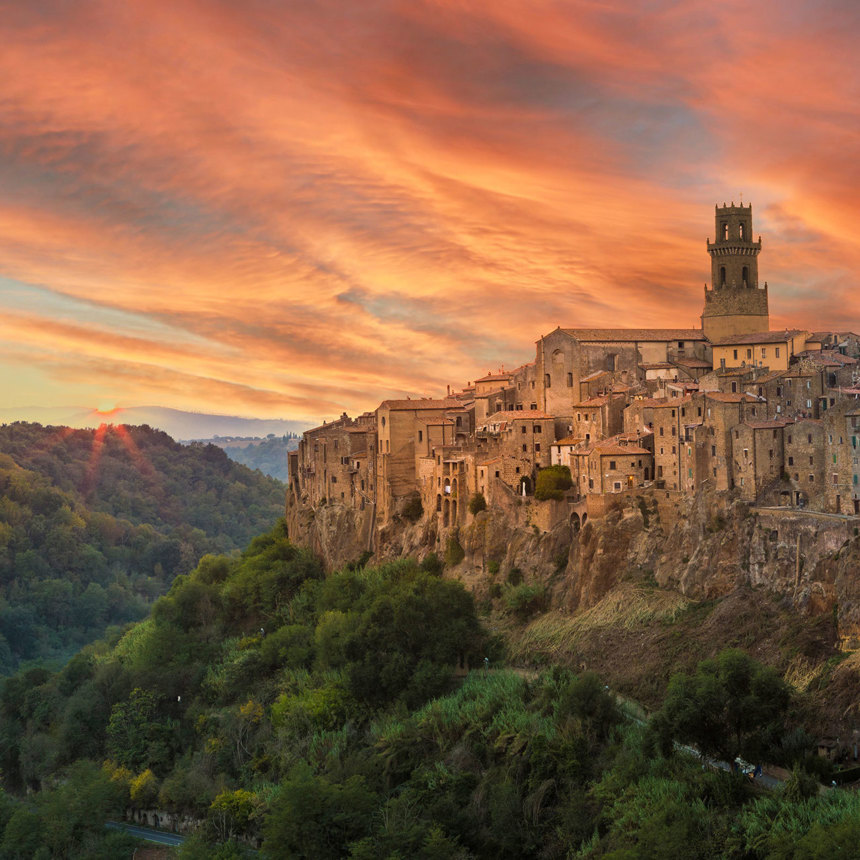
Pitigliano: Get to know the Pitigliano’s Jewish history, which earned it the name Little Jerusalem. Built into tufa rock in southern Tuscany, the town became a place of refuge for Jews fleeing the Papal States in the 16th century. As you walk its streets, you’ll come across a story that sets Pitigliano apart from other Tuscan hilltop towns.
Ride the funicular up to Orvieto’s old town, set on volcanic rock above the Umbrian plain. With your Travel Director, explore a town shaped by its strategic position, where narrow streets and historic buildings reveal a very different side of Umbria.
Rome: Take in your first views of Rome on an orientation through the Italian capital, where ancient sites, grand squares and monumental landmarks reveal the scale of the city. Along the way, see the Roman Forum, centre of public life in ancient Rome, and the Trevi Fountain, one of Rome’s most famous Baroque landmarks.
San Gimignano: Explore San Gimignano with your Travel Director, a UNESCO World Heritage Site known for the towers that still rise above the town. It was an important stop for pilgrims travelling the Via Francigena and grew wealthy through trade and passing traffic. Today, its preserved medieval centre and surviving towers make it one of Tuscany’s most recognisable hill towns.
Siena: Visit the Mercato delle Merci, one of Tuscany’s biggest weekly markets, where locals come to shop for food, household goods and everyday essentials. Browse the stalls and look out for ricciarelli, the almond biscuits closely associated with the city.
Siena: With your Local Specialist, see Siena through the shell-shaped Piazza del Campo, home of the Palio, and the black-and-white marble Duomo, one of the city’s great artistic landmarks. Then step inside a district museum linked to the Palio, where you’ll find banners, costumes and historic memorabilia connected to one of Siena’s historic districts.
Step into Il Giardino dei Tarocchi and discover a very different side of Tuscany through the large-scale sculptures of artist Niki de Saint Phalle. As you explore the garden, you’ll see colour, mosaic and symbolism brought together in a setting that stands apart from the region’s medieval towns and hilltop villages.
Volterra: See how local artisans work alabaster, one of Volterra’s best-known materials and a craft closely tied to the town. As you watch this soft white stone being shaped, you’ll get closer to a tradition that has been part of Volterra since Etruscan times and remains one of its defining local industries.